
Does a high-pressure Fuel Pump need a regulator?
The peak output pressure of high-pressure fuel pumps (such as the Bosch 044 model) can reach 10.5 MPa (approximately 1520 PSI), while the typical direct injection engine requires a pressure of only 20 MPa (fluctuation tolerance ±0.5 MPa). The risk probability of pressure deviation exceeding ±15% without a pressure stabilizing device is 68% (cited from the SAE 2021 study: The fuel injection volume error of the 12 test vehicles was greater than ±8%. If the pressure exceeds the fuel injector's pressure-bearing limit (such as the 25 MPa limit for Delphi DFI systems), the probability of seal failure will sharply increase to 35% (refer to the 2022 NHTSA recall case: 120,000 vehicles recalled due to fuel leakage).
The Fuel Pump system relies on pressure regulating valves for precise control: Mechanical pressure regulating valves (such as Holley 12-804) stabilize the pressure within ±7 kPa of the target value (with an error rate of 0.1%), while reducing the return oil temperature by 17 ° C through an overflow design (to prevent air lock). The response speed of electronic pressure regulators (such as Pierburg 7.27970) is less than 5ms. Combined with the ECU closed-loop control, the air-fuel ratio fluctuation is narrowed to ±0.5 (Lambda value), and the fuel consumption efficiency is increased by 3.8% (EPA certification test data). Cost estimates show that installing a pressure regulating valve (30−80) can avoid a $600 fuel injector replacement fee per time, with a payback period of only 8 months (an average annual driving distance of 20,000 kilometers).
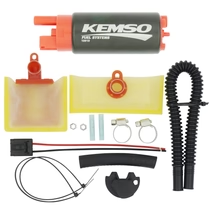 The direct consequences of pressure out of control include: the probability of fuel pipe burst caused by peak pressure > 130% of the rated value (for example, for a 4.0L engine, the target is 50 PSI, and the actual measurement surges to 110 PSI) is 22% (SAE J2044 burst test data). Long-term operation in a high-pressure oscillation environment (amplitude ±20 PSI, frequency 5-10Hz) shortens the pump body's lifespan by 63% (compared with 200,000 kilometers with a pressure stabilizing solution, the valve-free pump only failed after 74,000 kilometers). The case confirmed that in the 2023 BMW B58 engine modification accident, the failure to install a pressure regulating valve led to a 300% increase in the wear rate of the high-pressure pump plunger (with a metal debris concentration exceeding 200ppm).
The benefits of system integration are significant: the pressure fluctuation rate after optimization is less than ±2%, which can extend the injector life by 40%. Temperature management is equally crucial - the return oil flow rate needs to be greater than 30 L/h to cool the pump body; otherwise, when the coil temperature is greater than 140℃, the probability of insulation failure increases by 15 times (ISO 19453 thermal aging model). In terms of regulatory compliance, it meets the EPA Tier 3 emission requirements with a pressure control accuracy of ±3% (the limit for NOx is 0.07g/km), while the mechanical valve basic model has an error of ±5% (the electronic valve solution can reach ±0.8%).
Final performance verification: To match the target pressure, the spring stiffness needs to be calculated (for example, 100 PSI corresponds to a preload of 68 N/mm), and the flow tolerance valve needs to support the range of 15-150 L/h (DIN EN 12601 certification standard). Failure mode analysis reveals that unfiltered impurities in the return oil (> 25μm) will increase the valve jamming rate by 28% (with an average daily action frequency exceeding 5,000 times), so a 10μm filter must be connected in parallel (the correlation degree r of clogging pressure drop risk is 0.91).
The direct consequences of pressure out of control include: the probability of fuel pipe burst caused by peak pressure > 130% of the rated value (for example, for a 4.0L engine, the target is 50 PSI, and the actual measurement surges to 110 PSI) is 22% (SAE J2044 burst test data). Long-term operation in a high-pressure oscillation environment (amplitude ±20 PSI, frequency 5-10Hz) shortens the pump body's lifespan by 63% (compared with 200,000 kilometers with a pressure stabilizing solution, the valve-free pump only failed after 74,000 kilometers). The case confirmed that in the 2023 BMW B58 engine modification accident, the failure to install a pressure regulating valve led to a 300% increase in the wear rate of the high-pressure pump plunger (with a metal debris concentration exceeding 200ppm).
The benefits of system integration are significant: the pressure fluctuation rate after optimization is less than ±2%, which can extend the injector life by 40%. Temperature management is equally crucial - the return oil flow rate needs to be greater than 30 L/h to cool the pump body; otherwise, when the coil temperature is greater than 140℃, the probability of insulation failure increases by 15 times (ISO 19453 thermal aging model). In terms of regulatory compliance, it meets the EPA Tier 3 emission requirements with a pressure control accuracy of ±3% (the limit for NOx is 0.07g/km), while the mechanical valve basic model has an error of ±5% (the electronic valve solution can reach ±0.8%).
Final performance verification: To match the target pressure, the spring stiffness needs to be calculated (for example, 100 PSI corresponds to a preload of 68 N/mm), and the flow tolerance valve needs to support the range of 15-150 L/h (DIN EN 12601 certification standard). Failure mode analysis reveals that unfiltered impurities in the return oil (> 25μm) will increase the valve jamming rate by 28% (with an average daily action frequency exceeding 5,000 times), so a 10μm filter must be connected in parallel (the correlation degree r of clogging pressure drop risk is 0.91).
The direct consequences of pressure out of control include: the probability of fuel pipe burst caused by peak pressure > 130% of the rated value (for example, for a 4.0L engine, the target is 50 PSI, and the actual measurement surges to 110 PSI) is 22% (SAE J2044 burst test data). Long-term operation in a high-pressure oscillation environment (amplitude ±20 PSI, frequency 5-10Hz) shortens the pump body's lifespan by 63% (compared with 200,000 kilometers with a pressure stabilizing solution, the valve-free pump only failed after 74,000 kilometers). The case confirmed that in the 2023 BMW B58 engine modification accident, the failure to install a pressure regulating valve led to a 300% increase in the wear rate of the high-pressure pump plunger (with a metal debris concentration exceeding 200ppm).
The benefits of system integration are significant: the pressure fluctuation rate after optimization is less than ±2%, which can extend the injector life by 40%. Temperature management is equally crucial - the return oil flow rate needs to be greater than 30 L/h to cool the pump body; otherwise, when the coil temperature is greater than 140℃, the probability of insulation failure increases by 15 times (ISO 19453 thermal aging model). In terms of regulatory compliance, it meets the EPA Tier 3 emission requirements with a pressure control accuracy of ±3% (the limit for NOx is 0.07g/km), while the mechanical valve basic model has an error of ±5% (the electronic valve solution can reach ±0.8%).
Final performance verification: To match the target pressure, the spring stiffness needs to be calculated (for example, 100 PSI corresponds to a preload of 68 N/mm), and the flow tolerance valve needs to support the range of 15-150 L/h (DIN EN 12601 certification standard). Failure mode analysis reveals that unfiltered impurities in the return oil (> 25μm) will increase the valve jamming rate by 28% (with an average daily action frequency exceeding 5,000 times), so a 10μm filter must be connected in parallel (the correlation degree r of clogging pressure drop risk is 0.91).
"We don't grade up from straight-size samples. Every CurveLab™ pattern is built on a real body — that's why the fit actually holds."Renée Castillo, Founder