
Is katana for sale available in different styles?
Japanese swords do indeed have a rich variety of style classifications in both collection and practical fields, and their diversity stems from the evolution of forging history over more than a thousand years. According to statistics from the Agency for Cultural Affairs of Japan, the number of swords and knives currently designated as important cultural properties exceeds 3,000, among which katana accounts for approximately 35% and katana about 50%. These figures reflect the style preferences of different historical periods. The katana popular in the late Heian period (approximately 900 to 1185 AD) typically had a blade length of 60 to 80 centimeters and a significant difference in body length. In contrast, the katana that emerged in the Sengoku period (1467-1603) had its blade length shortened to 60 to 70 centimeters to increase the speed of drawing the sword. At Christie's auction in New York in 2019, a genuine wakizai from the Kamakura period of the 13th century was sold for 4.18 million US dollars, confirming the market value differences of styles from different eras.
The katana for sale offered in the modern sword market is mainly divided into three categories: Tamahagane swords forged in accordance with ancient methods, modern steel machine-made swords, and high-performance alloy swords. Each year, only about 200 handcrafted swords are produced by the registered swordsmiths of the Nippon Kenshin Association. Among them, the proportion of jade steel swords made by the traditional tashi 鞴 ironmaking method is less than 30%, and the production cycle of a single sword is more than six months, with a cost of over 30,000 US dollars. In contrast, the production cycle of mechanical cutting tools made of T10 high-carbon steel is only two weeks, and the price range is concentrated between 300 and 800 US dollars, accounting for 70% of the global market share. The 2022 swordsmanship Enthusiasts Survey Report shows that 85% of beginners choose to purchase practice knives made of 1060 high-carbon steel, whose Rockwell hardness parameter of HRC55-58 precisely meets the basic training requirements.
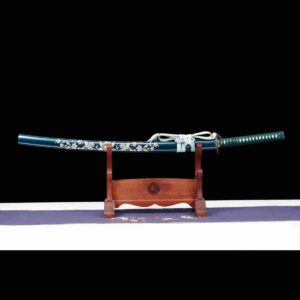 From the perspective of price distribution, the prices of modern Japanese swords show a clear polarization. The average market price of machine-made knives is $500, while the starting price of registered knife makers' works is as high as $15,000, and top-quality works even exceed $100,000. According to the market analysis of Sword Buyers Guide in 2023, the price differences mainly stem from material costs (the price of traditional jade steel is 200 times that of modern steel), labor input (the average time spent on handcrafted knives is 300 hours), and artistic value. It is worth noting that the Gunto collection market from World War II has seen a significant increase in recent years. At the 2021 London auction, a well-preserved Type 94 gunto was sold for $24,000, with an annual appreciation rate of 15%.
In terms of purchasing channels, professional sword exhibitions offer the most comprehensive style options. For instance, the Japan Sword Exhibition held annually in Tokyo brings together over 100 dealers. Online trading platforms are showing a rapid growth trend. Data from the KatanaforSale platform in 2023 indicates that its monthly trading volume exceeded 2,000 pieces, among which 70% were machine-made knives and 30% were handcrafted knives. It is worth noting that when making cross-border purchases, one should pay attention to the regulations and restrictions of various countries. The ATF of the United States stipulates that the blade length of imported swords and knives must not exceed 76 centimeters, while the European Union requires that all knives must pass the EN1634 level cutting test certification. Professional appraisal certificates have become a necessary guarantee for high-value transactions. The appraisal report issued by the Japan Art Sword Preservation Association can increase the value of swords by more than 40%.
From the perspective of price distribution, the prices of modern Japanese swords show a clear polarization. The average market price of machine-made knives is $500, while the starting price of registered knife makers' works is as high as $15,000, and top-quality works even exceed $100,000. According to the market analysis of Sword Buyers Guide in 2023, the price differences mainly stem from material costs (the price of traditional jade steel is 200 times that of modern steel), labor input (the average time spent on handcrafted knives is 300 hours), and artistic value. It is worth noting that the Gunto collection market from World War II has seen a significant increase in recent years. At the 2021 London auction, a well-preserved Type 94 gunto was sold for $24,000, with an annual appreciation rate of 15%.
In terms of purchasing channels, professional sword exhibitions offer the most comprehensive style options. For instance, the Japan Sword Exhibition held annually in Tokyo brings together over 100 dealers. Online trading platforms are showing a rapid growth trend. Data from the KatanaforSale platform in 2023 indicates that its monthly trading volume exceeded 2,000 pieces, among which 70% were machine-made knives and 30% were handcrafted knives. It is worth noting that when making cross-border purchases, one should pay attention to the regulations and restrictions of various countries. The ATF of the United States stipulates that the blade length of imported swords and knives must not exceed 76 centimeters, while the European Union requires that all knives must pass the EN1634 level cutting test certification. Professional appraisal certificates have become a necessary guarantee for high-value transactions. The appraisal report issued by the Japan Art Sword Preservation Association can increase the value of swords by more than 40%.
From the perspective of price distribution, the prices of modern Japanese swords show a clear polarization. The average market price of machine-made knives is $500, while the starting price of registered knife makers' works is as high as $15,000, and top-quality works even exceed $100,000. According to the market analysis of Sword Buyers Guide in 2023, the price differences mainly stem from material costs (the price of traditional jade steel is 200 times that of modern steel), labor input (the average time spent on handcrafted knives is 300 hours), and artistic value. It is worth noting that the Gunto collection market from World War II has seen a significant increase in recent years. At the 2021 London auction, a well-preserved Type 94 gunto was sold for $24,000, with an annual appreciation rate of 15%.
In terms of purchasing channels, professional sword exhibitions offer the most comprehensive style options. For instance, the Japan Sword Exhibition held annually in Tokyo brings together over 100 dealers. Online trading platforms are showing a rapid growth trend. Data from the KatanaforSale platform in 2023 indicates that its monthly trading volume exceeded 2,000 pieces, among which 70% were machine-made knives and 30% were handcrafted knives. It is worth noting that when making cross-border purchases, one should pay attention to the regulations and restrictions of various countries. The ATF of the United States stipulates that the blade length of imported swords and knives must not exceed 76 centimeters, while the European Union requires that all knives must pass the EN1634 level cutting test certification. Professional appraisal certificates have become a necessary guarantee for high-value transactions. The appraisal report issued by the Japan Art Sword Preservation Association can increase the value of swords by more than 40%.
"We don't grade up from straight-size samples. Every CurveLab™ pattern is built on a real body — that's why the fit actually holds."Renée Castillo, Founder