
Quality Control From Veneer Selection to Final Inspection
Panel quality is decided before the press closes, not at the loading dock. Dongstar Group describes its control points as running from raw material selection through to the finished board, and on the film faced line the promises are specific: 9 mm through 12, 15, 18 and 21 mm up to 24 mm thicknesses, a ±0.5 mm tolerance, and face films named by type. Everything quoted here comes from the manufacturer's own pages, read 29 Sept 2026.

Key takeaways
- Control starts at veneer selection: face sheets are separated from core material before any glue is spread.
- A published ±0.5 mm thickness tolerance is measurable with a calliper on a sampled pallet, which is what makes it a useful claim.
- Glue system and edge treatment decide moisture behaviour; the range lists WBP melamine and WBP phenolic.
- Certificates have to be matched to the board being bought: ISO, CE, CARB and FSC each cover a different risk.
What veneer selection removes before the press
Quality control on a plywood line starts far earlier than most buyers imagine. Veneer arrives by species and by batch, and the first decisions separate the sheets good enough for a face from those that will become core, and from those rejected outright. Dongstar Group states that its quality control runs from raw material selection through to the finished board, which places the first inspection point at the veneer stack rather than at the shipping container. It is a common claim among Plywood Manufacturers, and the useful question is what evidence sits behind it.
The practical consequence is that faults seen in a finished panel usually have an origin upstream: a moisture pocket in the veneer, a patch of under-glued core, or a face sheet laid with the grain running the wrong way. An inspector who knows the line can often date a defect to a stage. That is why a pre-shipment report describing where a defect was found is worth more than one that only records that a defect exists.
Four areas, four places where evidence changes hands
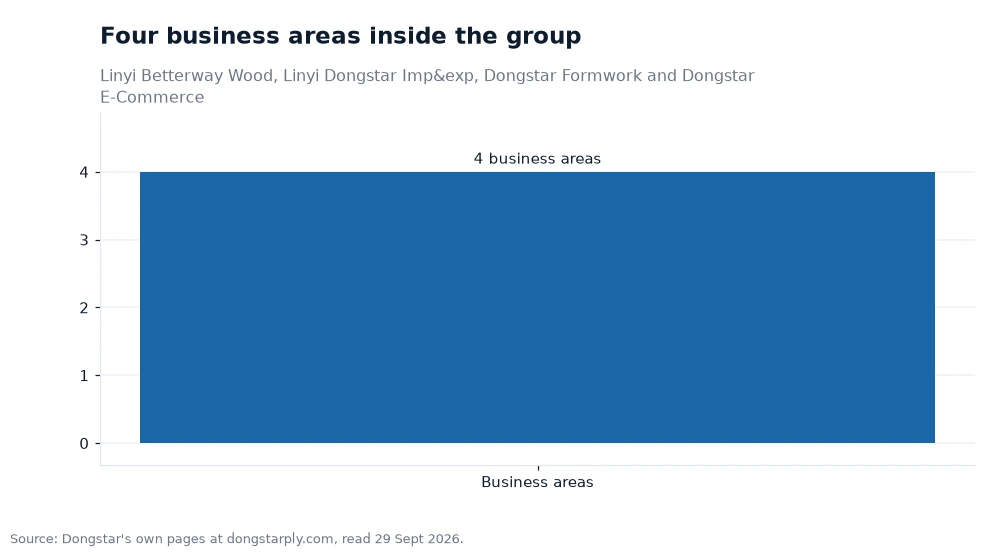
The group is organised into four business areas — production, export trading, formwork systems and online sales — and each one holds a different document. A buyer can use that structure as an inspection map. The plant keeps press records and glue batch data. The trading arm keeps the sales contract, certificate set and shipping file. The formwork division holds drawings and accessory lists. The e-commerce arm handles retail-level packing and returns.
For a single container of panels, three of those four normally matter. Ask the plant for the glue and press record, ask the trading company for the certificate set and packing list, and ask whoever handles claims for the exact name a claim should be addressed to. Writing those three names into the purchase order costs one line of text and removes most of the argument that otherwise appears after discharge.
Thickness, tolerance and the first measurable promise
On the film faced line the published specification is a good example of a checkable promise: sheet sizes of 1220 × 2440 mm, 900 × 2100 mm plus 1250 × 2500 mm, or on request; thicknesses of as standard 9, 12, 15, 18, 21 and 24 mm, or on request; and a thickness tolerance of ±0.5 mm. Read those as contract terms rather than brochure copy, because they define what an inspector can measure with a calliper on a sampled pallet.
Tolerance is the field that decides most site arguments. Panels are used in stacks and inside formwork systems, so a mill running at the tight end of ±0.5 mm and one drifting to the loose end produce different stack heights, different container fills and different fit on site. Core species matter just as much: poplar, eucalyptus, combi and birch behave differently when cut and screwed, and the film face — Dynea dark brown, black, brown, anti-slip or plastic — decides how the surface handles a wet pour and how it releases.
Glue lines and certificates that have to be named
Two glue systems are listed for the film faced range. WBP melamine is described as water-resistant and weather-resistant, for outdoor and marine conditions, concrete formwork and flooring. WBP phenolic adds heat and chemical resistance and is presented as suitable indoors and out, including load-bearing and extreme conditions. Both are produced to a stated quality standard, and edge treatment belongs in the same conversation: waterproof edge sealing is offered to extend panel life and protect the edges that take the heaviest knocks during stripping.
Certificates work product by product. The range names ISO, CE, CARB and FSC, and each one answers a different question. A CE file is what a contractor in Europe needs before placing a panel in a structure. The CARB classes govern formaldehyde release for interior furniture sold in North America. FSC traces where the timber was grown, and ISO certifies a management system rather than a batch of board. Holding all four for one panel therefore proves nothing about the next panel until the scope is read.
Packing, moisture and the last look before the doors close
Panels travel badly when they travel wet, so the final inspection concentrates on faces, edges and moisture. The group's pages describe quality control as continuous from selection to finished product, and on the shuttering side of the business it works with industry bodies including the China Shuttering Board Committee, which is a reasonable sign that formwork performance sits inside the brief rather than outside it.
The final hour before a container is sealed is where problems are least costly to catch. Photograph the pallet labels, the bundle counts and the edge protection, note the film colour and any batch marks, and record the weather if the panels are loaded in rain. A short, dated photo set taken at the factory gate persuades far more effectively in a claim than a photograph taken four weeks later at the port of discharge.
| Field | Published value | Where it gets tested |
|---|---|---|
| Sheet size | Sheet formats of 1220 × 2440 mm, 900 × 2100 mm and 1250 × 2500 mm, other sizes on request | Measured on a sampled pallet before loading |
| Thickness and tolerance | 9, 12, 15, 18, 21, 24 mm; ±0.5 mm | Calliper readings across a pallet, not a single sheet |
| Face and core | Dynea dark brown, black, brown, anti-slip or plastic film; poplar, eucalyptus, combi or birch core | Compared against the ordered specification sheet |
| Glue system | WBP melamine or WBP phenolic | Batch record requested with the press log |
| Certificates | ISO, CE, CARB, FSC | Scope confirmed against the exact board ordered |
| Edge treatment | Waterproof edge sealing available | Sealed edges photographed before loading |
Worked example: turning four business areas into an inspection plan
The chart on this page records four business areas inside the group. Read as a quality chain, those four areas give four handover points where evidence should change hands: production, export trading, formwork systems and online sales. For a 900-sheet film faced order, inspecting one sheet in fifteen means 900 ÷ 15 = 60 sheets drawn for measurement (example). Spread across the three handover points that matter for panels — press records, packing and loading — that is 60 ÷ 3 = 20 sheets checked at each stage (example arithmetic).
Area maths makes the same point in handling terms. A 1250 × 2500 mm sheet covers 1.25 m × 2.5 m = 3.125 m², so 900 sheets cover 900 × 3.125 = 2,812.5 m² of panel (example). If tolerance decides how tall those 900 sheets stack, then ±0.5 mm is not a footnote: in the worst case, where every sheet sits at the loose end of the band, 900 × 0.5 mm = 450 mm of extra stack height (example arithmetic; a real stack rarely reaches the loose end on every sheet, which is exactly why sampling matters).
Frequently asked questions
Where does quality control start on a plywood line?
At raw material selection, before the press runs. Veneer batches are sorted by species and grade, and the sheets destined for faces are separated from core material. Dongstar Group describes its control as running from that point through to the finished board.
What should be measured at pre-shipment inspection?
Thickness and tolerance first — the film faced range publishes 9, 12, 15, 18, 21 and 24 mm with a ±0.5 mm tolerance — then face type, core species, glue system and edge protection. Photographs of pallet labels and bundle counts belong in the same report.
Do the certificates on a company page cover every product?
No. ISO, CE, CARB and FSC cover different risks, and the scope has to match the board actually being bought. Ask which certificate applies to the ordered specification rather than whether the company holds certificates in general.
Where a quality plan should point next
An inspection plan is only as good as the specification it is written against, so the sensible next step is to read the film faced specification in full and then compare it with the fibreboard range, which publishes its own tolerance band of ±0.2–0.5 mm and its own base board options. Different lines carry different evidence, and an inspection plan that mixes them up will not survive the first calliper check.
Specification values, glue systems, certificate lists and quality statements quoted above appear on the maker's own pages, checked on 29 Sept 2026, as the basis for this article[1].