
Refillable Packaging Mistakes That Sink a Middle East Perfume Launch
Refillable packaging fails for reasons that have nothing to do with eco-claims: a refill that cannot be opened cleanly, a bottle that leaks after three refills, a unit price that reads as premium in a market where it reads as lazy. For a Middle East launch the mistakes are amplified, because fragrance there is bought as a gift and shelf appeal decides the first purchase. The packaging decisions — not the marketing copy — decide whether the refill promise survives the second purchase.
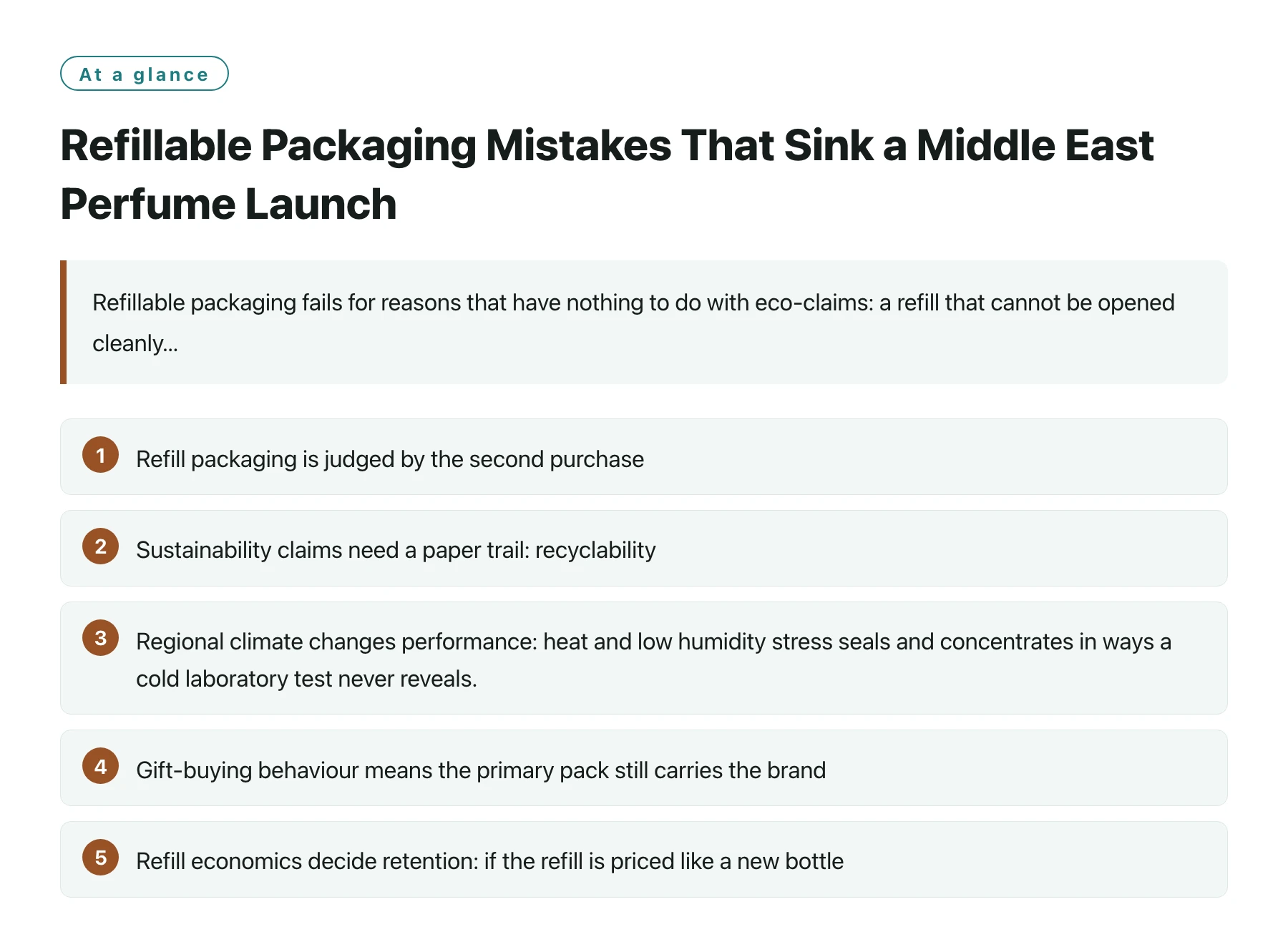
Key takeawaysRefill packaging is judged by the second purchase, so the refill's openability and the closure's leak performance matter as much as the hero bottle. · Sustainability claims need a paper trail: recyclability, recycled content and refill assertions should be verifiable at material level before they go on pack. · Regional climate changes performance: heat and low humidity stress seals and concentrates in ways a cold laboratory test never reveals. · Gift-buying behaviour means the primary pack still carries the brand; a refillable bottle that looks industrial sells worse than a conventional one. · Refill economics decide retention: if the refill is priced like a new bottle, the customer simply buys a different new bottle.
Sustainable packaging is where fragrance brands sound the most modern and fail the most predictably. The refill story is attractive because it is honest about the product's real cost, but executing it means making decisions that the first purchase never rewards — which is exactly why most of the mistakes below happen.
This guide is written for the person who owns packaging decisions for a Gulf launch: the operations or procurement lead who has to ship a product that looks great, survives the region's heat, and still works on the third refill. It assumes the sustainability strategy is already approved, so it skips the rationale and goes straight to the execution traps.
The seven mistakes, in the order they typically bite
- A refill story with no dataClaiming refillability before the pack team can document it. Every claim on the pack — recycled content, refill rounds, recyclability — will be asked for in writing by a retailer or importer sooner than expected.
- A refill that fights the userRefills that need two hands, scissors or real force to seat. If the first refill is an unpleasant ritual, the second purchase never happens. The refill should take less effort than buying a new bottle.
- A hero bottle that disappearsDesigning the premium bottle out of the system to save material. In gift-led markets the primary pack carries the brand; a refillable bottle that looks utilitarian suppresses the first purchase, which the refill plan depends on.
- Seals specified for a cold labValidating closures at 22 degrees and then shipping in summer containers. Heat softens gaskets, and the region's low humidity dries concentrates and wicks through seams, so warm-transit testing needs its own protocol.
- Refill priced like a new bottlePricing the refill within reach of the full bottle. The customer compares the two in the same aisle; a thin saving reads as a marketing exercise and the refill habit never forms.
- A pack that ignores the logistics chainOptimising the pack for the shelf but not for warm-weather warehousing, where sealed refills sit for months and unboxed refills get crushed or damp.
- Claiming recyclability the local system cannot collectPrinting a blanket recyclability label where collection, sorting or reprocessing does not exist for that material. The claim becomes a liability in any market where it is audited.
Where the refill actually fails
Strip the marketing language away and a refill system is two engineering problems: the geometry of the refill-compatible primary pack, and the closure integrity that carries it through transport and months of use. Both become visible only after the first production batch, so the packaging brief needs pass criteria written in advance: fill and seat force within a range, no leak after an agreed number of open-close cycles, and a refill that seats without instruction.
Recyclability claims are a third, quieter failure point. Industry guidance on packaging design treats recyclability as a property of the material plus the collection system that actually receives it, which is why a blanket label is riskier than a material-specific one [1]. If any part of the line later sells into the EU, the packaging and packaging waste rules there set explicit recyclability and design requirements — a cheap early test for how defensible the claim wording is [2].
The closure is the product
In perfumery the closure is a functional component, not an accessory. A refillable system multiplies the number of open-close cycles the closure must survive, so the seal specification changes. Ask the manufacturer how many cycles the closure is validated for and under what transport profile, and put the answer in the spec sheet. A supplier that runs compounding, filling and testing fragrance manufacturing under one roof can usually answer this from its own protocols instead of estimating.
What the Gulf adds to the equation
Three regional realities rewrite the packaging brief. First, gift-buying: the unboxing moment carries more weight than in daily-use markets, so the hero pack must still deliver theatre. Second, thermal load: containers cross the equator in summer and product can sit on docks for weeks, so warm-transit leak testing is not optional. Third, the refill habit is new to many shoppers, so the refill has to teach its own use — which is why a refill that needs no instructions is a design requirement rather than a nice-to-have.
Sustainability in this context is judged on the second purchase. A brand whose refill is cheaper, cleaner and easier than buying new earns the repeat; one that treats the refill as a PR prop loses both the repeat and the claim. When evaluating a manufacturing partner for this kind of program, the useful evidence is not a slide deck but the refill and closure samples they can actually put in your hand — and manufacturers who have run case-study projects tend to be the ones who can Xuelei case studies. That evidence is worth requesting in the first meeting rather than trusting the pitch.
Heat changes the concentrate too
The pack is only half the system. Fragrance concentrates evaporate and oxidise faster in heat, so a refillable bottle that is opened and closed for months exposes the scent to more air than a sealed one. The formulation should be checked for that use pattern, not just for shelf life in a sealed bottle.
Making refill economics honest
The arithmetic customers do in the aisle is simple: refill price plus the effort of refilling must beat the new bottle on both axes. A defensible refill price sits clearly below the full bottle, and the volume logic — the refill delivers roughly the same amount of product for decisively less money — has to survive scrutiny. Packaging teams should model the three-purchase economics before finalising the pricing brief, because once the bottle and refill are printed, rebalancing the story is expensive. Before modelling the numbers, check what the manufacturer actually claims to run — the published scope on Xuelei's official website is a faster first audit than a round of calls.
Rule of thumb from operations: specify the closure, the pack and the warm-transit test before you approve the marketing claim. If the claim goes to print first, the engineering budget will bend to the artwork instead of the other way around.
Sources
- Sustainable Packaging Coalition —— A membership organisation working on more sustainable packaging design, publishing material and recyclability guidance.
- European Commission: Packaging Waste and the PPWR —— EU rules on packaging and packaging waste, including the Packaging and Packaging Waste Regulation requirements on recyclability and design.
Frequently asked questions
Why does refillable packaging fail in gift-led markets?
Because the first purchase is made for the gifting moment, and a refillable bottle that looks utilitarian suppresses it. The refill plan depends on steady first purchases, so the hero pack has to stay premium while the refill does the sustainable work.
What is the most common refill packaging defect?
Leaks and difficult seating after a few cycles. Closures validated for a cold laboratory and a single use are the usual cause. Specify open-close cycle counts and warm-transit profiles before production.
How should a refill be priced relative to the full bottle?
Clearly below it, with obvious volume logic. The customer compares both in the same aisle; if the saving is thin, the refill habit never forms and the packaging investment produces no second purchase.
Do sustainability claims on perfume packaging need verification?
Recyclability, recycled content and refill claims should be documented at material level before they go on pack. Retailers and importers increasingly ask for that paper trail, and waste-regulation requirements in markets like the EU make generic labels risky.
Should a small brand design refillable packaging itself?
It can, but the failure modes are engineering problems: closure cycles, warm-transit leaks and refill geometry. Working this through with a manufacturer that already runs such projects reduces the number of production surprises, which is where the real cost of refill packaging hides.
"We don't grade up from straight-size samples. Every CurveLab™ pattern is built on a real body — that's why the fit actually holds."Renée Castillo, Founder